User-agent: * Allow: / Trip to Italy April 2007: Unesco
Showing posts with label Unesco. Show all posts

Friday, 22 June 2007

OUR TRIP TO ITALY APRIL 2007 - VERONA

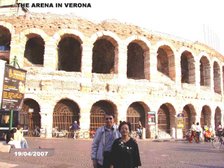
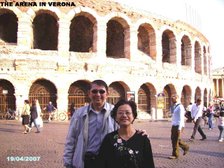
Next we travelled to the ancient town of Verona which boast the Famous scene of Romeo & Juliet on the balcony and also a small complete Roman Arena.

"There is no world without Verona walls,But purgatory, torture, hell itself.Hence-banished is banish'd from the world,And world's exile is death."
—William Shakespeare, Romeo and Juliet, Act III, Scene III

Verona is a city and provincial capital in Veneto, Northern Italy.
Verona, or Veronia, was a city of the Euganei,
who were obliged to cede it to the Cenomani (550 BC).
The city derived importance from being at the intersection of many roads.
Because of the value and importance of its many historical buildings,
Verona has been named a UNESCO world heritage site.
San Zeno Basilica, like many other Veronese churches,
is built with alternating layers of white stone and bricks.
Verona is famous for its Roman amphitheatre, the Arena,
completed around 30 AD, which is the third largest in Italy,
after Rome's Colosseum and the arena at Capua.
It measures 139 meters long and 110 meters wide, and
could seat some 25,000 spectators in its 44 tiers of marble seats.
The interior is very impressive and is virtually intact, and
has remained in use even today for public events, fairs, theatre
and open-aired opera during warm, Summer nights.
There is also a variety of other Roman monuments to be found in the town,
such as the Roman theatre.
The Arco dei Gavi (Gavi Arch), dedicated to the important Roman family
of the Gavii, was built in the 1st century AD, and is famous for having
the name of the builder (architect Lucius Vitruvius Cordone) engraved on it,
a really rare case in the architecture of the epoque.
It originally it straddled the main Roman road into the city,
now the Corso Cavour.
Nearby is the Porta dei Borsari, an archway is at
the end of Corso Porta Borsari. This is the façade of a
3rd century gate in the original Roman city walls.
The inscription is dated 245 AD and gives the city name
as Colonia Verona Augusta. The road passing through the gate
is the original Via Sacra of the Roman city.
Today, it is lined with several Renaissance palazzi.
Porta dei Leoni is the 1st century BC ruin of what was
once part of the Roman city gate. A substantial portion is still
standing as part of the wall of a medieval building. The street itself is
an open archaeological site, and the remains of the original Roman
street and gateway foundations can be seen a few feet below the present street level.

The Basilica of San Zeno Maggiore is considered one of the
great achievements of Romanesque architecture.
The present structure is the 3rd on this site,
built from 1123-1135, over the 4th century shrine to
Verona's patron saint, St. Zeno (died 380).
The splendid façade dominates the large square,
and is flanked with a beautiful 72 meter tall bell tower,
which is mentioned by Dante in Canto 18 of Purgatory in the Divine Comedy.
The weathered Veronese stone gives a warm golden glow and
the restrained lines of the pillars, columns, cornices and the gallery
with its double windows give the façade an air of harmonious elegance.
The lintels above the portal have carvings of the months of the year.
Each side of the doorway is embellished with 18 bas-relief panels of
biblical scenes, and the inner bronze door has panels have 48 primitive
but forceful Biblical scenes and depictions from the life of St Zeno.
The interior of the church is divided into a Lower Church,
occupying about 2/3 of the structure, and the Upper Church,
occupying the remainder. The walls are covered with
12th and 14th century frescos and the ceiling of the nave
is a magnificent example of a ship's keel ceiling.
The vaulted crypt contains the tomb of St. Zeno,
the first Bishop of Verona as well as the tombs of several other saints.
North of the church is a pleasant cloister.
The church also houses the tomb of King Pippin of Italy (777-810).
The small Romanesque Basilica of San Lorenzo is one of the finest and
most important in the city. Its dates from around 1177, but is built on
the site of a Paleochristian church, some fragments of which remain.
Santa Maria Antica is a huge Romanesque church was the parish church
of the Scaligeri clan. Founded in the 7th century, the interior is very beautiful.
The structure is of alternating bands of brick and stone.
The square belfry has Gothic mullioned windows, and
inset glass crosses in the roof admit light.
Only large enough to hold a couple dozen people at most for mass,
when the Scaligeri chose this to be their funerary chapel,
the only place for their massive tombs was outside.
The Duomo is also a notable Romanesque church.
Sant'Anastasia is a huge and lofty church built from 1290-1481
by the Dominicans to hold the massive congregations attracted by
their rousing fundamentalist sermons. The Gothic portal has faded
15th century frescoes and carved scenes from the life of St Peter Martyr,
but the façade is unfinished. Inside is one of the most outstanding examples of Gothic architecture in northern Italy. However, its proportions and various elements of the design are still decidedly Romanesque.

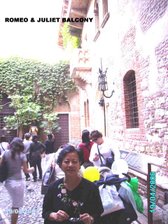
The famous balcony of Juliet at Villa Capelletti in Verona.
Verona is the setting of the story of Romeo and Juliet, made famous by
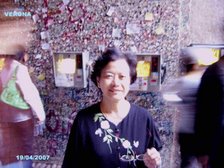
William Shakespeare. The short passageway leading to the balcony is
covered with slips of paper carrying their graffiti of love notes, and
a bronze statue of Juliet stands under the balcony,
one breast polished by those touching it for luck.

Wednesday, 20 June 2007

OUR TRIP TO ITALY APRIL 2007 - PISA

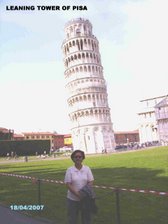
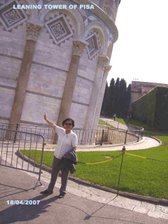
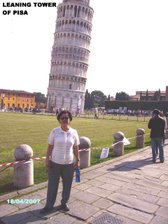
The Leaning Tower of Pisa is the freestanding bell tower,
of the cathedral of the Italian city of Pisa.
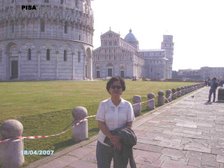
It is situated behind the Cathedral and
it is the third structure in Pisa's Campo dei Miracoli (field of Miracles).
Although intended to stand vertically,
the tower began leaning to the southeast
soon after the onset of construction in 1173
due to a poorly laid foundation and loose substrate
that has allowed the foundation to shift direction.
The height of the tower is 55.86 m (183.27 ft) from the ground
on the lowest side and 56.70 m (186.02 ft) on the highest side.
The width of the walls at the base is 4.09 m (13.42 ft)
and at the top 2.48 m (8.14 ft). Its weight is estimated at 14,500 tonnes.
The tower has 294 steps. The tower leans at an angle of 5.5 degrees.
This may not seem a lot, but this means that the tower is 4.5 metres
from where it used to stand vertically.
The Tower of Pisa was a work of art,
performed in three stages over a period of about 174 years.
Construction of the first floor of the white marble campanile
began on August 9, 1173, a period of military success and prosperity.
This first floor is surrounded by pillars with classical capitals,
leaning against blind arches.
The tower began to sink after construction progressed to the third floor.
In an effort to compensate for the tilt,
the engineers built higher floors with one side taller than the other.
This made the tower begin lean in the other direction.
Because of this, the tower is actually curved.
After a phase (1990-2001) of structural strengthening,
the tower is currently undergoing gradual surface restoration,
in order to repair visual damage, mostly corrosion and blackening.
These are particularly strong due to the tower's age and
to its particular conditions with respect to wind and rain.
On February 27, 1964, the government of Italy requested aid
in preventing the tower from toppling.
It was, however, considered important to retain the current tilt,
due to the vital role that this element played in
promoting the tourism industry of Pisa.
A multinational task force of engineers, mathematicians and historians
was assigned and met on the Azores islands to discuss stabilization methods.
After over two decades of work on the subject,
the tower was closed to the public in January 1990.
While the tower was closed, the bells were removed to relieve some weight,
and cables were cinched around the third level
and anchored several hundred meters away.
Apartments and houses in the path of the tower
were vacated for safety.
After a decade of corrective reconstruction and stabilization efforts,
the tower was reopened to the public on December 15, 2001.
It was found that the lean was increasing due to the stonework
expanding and contracting each day due to the heat of sunlight.
This was working in combination with the softer foundations
on the lower side.
Many methods were proposed to stabilize the tower,
including the addition of 800 metric tons of
lead counterweights to the raised end of the base.
The final solution to prevent the collapse of the tower
was to slightly straighten the tower to a safer angle,
by removing 38 m3 of soil from underneath the raised end.
The tower has been declared stable for at least another 300 years.
In 1987, the tower was declared as part of the Campo dei Miracoli
UNESCO World Heritage Site along with neighbouring cathedral,
baptistery and cemetery.
Movies associated with the leaning tower of Pisa:
The movie Superman III features an evil Superman
doing several "bad deeds" around the world -
one of which is straightening the Leaning Tower of Pisa,
played to comedic effect.
The famous final scene of the film features Superman
pushing the tower back to its normal inclination.

In the Disney movie Sky High, the very beginning shows
Will Stronghold's superhero mom getting "take out"
pizza from Italy. In one shot of the comic strip,
she is seen with a pizza box, flying past the Leaning Tower of Pisa.

On a Tool Time segment on Home Improvement,
Tim Taylor shows a picture of the tower as
an example of how men create and build masterpieces with tools.

In the Disney movie the Return of Jafar,
the Genie's song 'Nothing in the world' refers to
the Leaning Tower of Pisa where,
comically, the Genie is seen cycling into the tower,
which falls on top of him.

Tuesday, 19 June 2007

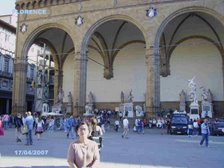
OUR TRIP TO ITALY APRIL 2007 - FLORENCE

Next from SIENA we travel to the important city of Florence.

Florence is the capital city of the region of
Tuscany, Italy.
From 1865 to 1870 the city was also the capital of
the Kingdom of Italy. Florence lies on the Arno
River and has a population of around 400,000
people, plus a suburban population in excess of
200,000 persons. The greater area has some
956,000 people. A center of medieval European
trade and finance, the city is often considered the
birthplace of the Italian Renaissance and was long
ruled by the Medici family. Florence is also famous
for its magnificent art and architecture. It is said
that, of the 1,000 most important European artists
of the second millennium, 350 lived or worked in
Florence. The city has also been called the Athens
of the Middle Ages.
The historic Center of Florence was declared a
World Heritage Site by the UNESCO in 1982.
The best-known site and crowning architectural
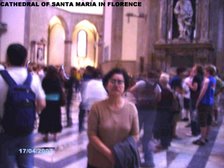
jewel of Florence is the domed cathedral of the
city, Santa Maria del Fiore, known as The Duomo.
The magnificent dome was built by Filippo
Brunelleschi.
The nearby Campanile tower and the Baptistery

buildings are also highlights. Both the dome itself and the
campanile are open to tourists and offer excellent
views.
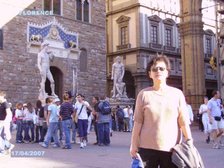
At the heart of the city in Piazza della Signoria is
Bartolomeo Ammanati's Fountain of Neptune,
which is a masterpiece of marble sculpture at the
terminus of a still functioning Roman aqueduct.
One of the bridges in particular stands out as
being unique — The Ponte Vecchio (Old Bridge),
whose most striking feature is the multitude of
shops built upon its edges, held up by stilts. The
bridge also carried Vasari's elevated corridor
linking the Uffizi to the Medici residence.

First constructed by the Etruscans in
ancient times, this bridge is the only one in the
city to have survived World War II intact.
The San Lorenzo contains the Medici Chapel, the
mausoleum of the Medici family - the most
powerful family in Florence from the 15th to the
18th century. Nearby is the Uffizi Gallery, one of
the finest art galleries in the world - founded on a
large bequest from the last member of the Medici
family.
The Uffizi itself is located on the corner
of Piazza della Signoria, a site important for three
main reasons:
In 1301, Dante was sent into Exile from here (a
plaque on one of the walls of the Uffizi
commemorates the event). In 1497,

it was the location of the Bonfire of the
Vanities
(a plaque in the middle of the plaza
commemorates that event), followed in 1498 by
the execution of its instigator, Girolamo
Savonarola
In 1504, it was the original location of
Michelangelo's David (now replaced by a
reproduction as the original was moved indoors to
the Accademia dell'Arte del Disegno), in front of
the Palazzo della Signoria (also known as Palazzo
Vecchio). In addition to the Uffizi, Florence has other
world-class museums:
The Bargello concentrates on sculpture,
containing many priceless works of art created by
such sculptors as Donatello, Giambologna, and
Michelangelo.
The Accademia dell'Arte del Disegno (often simply
called the Accademia) collection's highlights are
Michelangelo's David and his unfinished Slaves.
Across the Arno river is the huge Pitti Palace containing
part of the Medici family's former private
collection. In addition to the Medici collection the
palace's galleries contain a large number of
Renaissance works, including several by Raphael
and Titian as well as a large collection of modern
art, costumes, cattiages, and porcerlain. Adjoining
the Palace are the Boboli Gardens, elaborately
landscaped and with many interesting sculptures.
The elaborate Santa Croce church contains the
monumental tombs of Galileo, Michelangelo,
Machiavelli, Dante (actually a cenotaph), and many
other notables.

Other important basilicas in Florence include
Santa Maria Novella, San Lorenzo, Santo Spirito
and the Orsanmichele.
Florence has been the setting for numerous works
of fiction and movies, including the novels and
associated films Hannibal, Tea with Mussolini and
A Room with a View.


Notable residents

Leone Battista Alberti, polymath.

Dante Alighieri, The famous poet & writer

of La Divina Commedia.(Divine Comedy)

Filippo Brunelleschi, famous architect.

Giovanni Boccaccio, famous poet.

Giotto di Bondone, early Trecento painter of the
Arena Chapel in Padua, the Bardi and Peruzzi
chapels in the Basilica di Santa Croce di Firenze,
and many great panel works including the
Ognisanti Madonna .

Michelangelo Buonarroti, a famous sculptor, also
famous for the ceiling of the Sistine Chapel.

Medici Family

Girolamo Mei, historian and humanist

Lorenzo Ghiberti, sculptor

Donatello, sculptor

Raphael, painter.

Leonardo da Vinci, famous for his Mona Lisa and
other paintings, inventions, and scientific
experiments.

Niccolò Machiavelli, famous Renaissance poet and
philosopher

Giorgio Vasari, painter, architect, and historian

Galileo Galilei, Italian physicist, astronomer, and
philosopher.

Vincenzo Galilei Frescobaldi Family, notable bankers and wine
producers

Oriana Fallaci, journalist and author

Florence Nightingale, pioneer of modern nursing,
and a noted statistician.


The number of important authors, painters, sculpters, scientist, politician, architects and nursing legends made Florence a famous city both for its impotance and culture. The Academia museum which holds the original Michaelangelo's David, many original paintings by Raphael, works by Leonardo Da Vinci had to be booked in advance for several months so for mere tourists like us there were no hope of entering.

Monday, 18 June 2007

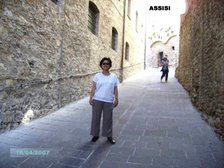
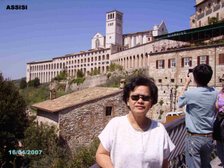
OUR TRIP TO ITALY APRIL 2007 - ASSISI

The next day we were again on the move now to the middle part of Italy where we will go to two Medieval cities ASSISI and SIENA both of which are World Heritage Sites under the UNESCO proctection and funding. It was a long journey with breaks along the way. OM the way we saw many olive and grapes farms.
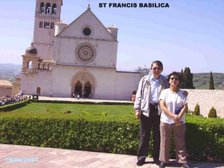
Assisi is a town in Italy in province of Perugia, Italy, in the Umbria region, on the western flank of Mt. Subasio. It is the birthplace of St. Francis, who founded the Franciscan religious order in the town in 1208, and St. Clare , the founder of the Poor Clares. Saint Gabriel of Our Lady of Sorrows of the 19th century was also born in Assisi.
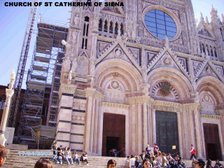
Now the site of many a pilgrimage, Assisi is linked in legend with its native son, St. Francis. The gentle saint founded the Franciscan order and shares honors with St. Catherine of Siena as the patron saint of Italy. He was a son of a rich man who disowned him in front of all the town's people for joining the Catholic priesthood. He is remembered by many, even non-Christians, as a lover of nature (his preaching to an audience of birds is one of the legends of his life). He is the patron saint of all Animals.
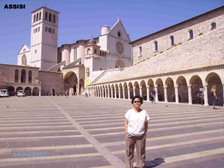
The Basilica of San Francesco d'Assisi (St. Francis) is a World Heritage Site. The Franciscan monastery and the lower and upper church of St Francis were begun immediately after his canonization in 1228, and completed 1253. The lower church has frescos by renowned late-medieval artists Cimabue and Giotto; in the Upper church are frescos of scenes in the life of St Francis by Giotto and his circle.
On September 26, 1997 Assisi was struck by an earthquake. The Basilica was badly damaged (part of the vault collapsed, killing four people inside the church and carrying with it a fresco by Cimabue), and was closed for two years for restoration.
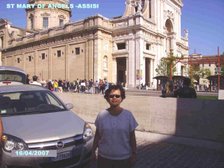
Santa Maria Maggiore, (St. Mary the Greater) the was the earliest extant church.
The Cathedral of San Rufino (St. Rufinus), with a Romanesque façade with three rose windows and a 16th-century interior; part of it is built on a Roman cistern.
Basilica of Santa Chiara (St Clare) with its massive lateral buttresses, rose window, and simple Gothic interior, begun in 1257, contains the tomb of the saint and 13th-century frescoes and paintings.

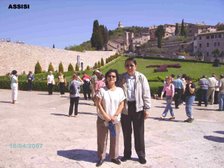
Besides the main Basilica of St Franscis was a small town with many shops selling souveniers to tourists and pilgrims. There was a place for taking taxis and buses. There were many roads and alleys to be explore in the town.

Friday, 15 June 2007

OUR TRIP TO ITALY APRIL 2007 -POMPEII

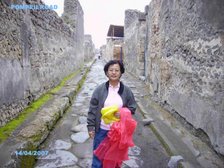
Next we travelled towards Naples to see the ancient ruins of Pompeii well described in the movie "The Last days of Pompeii". It was a long journey and we could see many olive trees and grapes vines along the route. Nearing Naples we could see the majestic Mount Vesuvius which is apparently dormant but still a very active volcano.Finally we came to the entrance of the excavation site of Pompeii.
Pompeii is a ruined Roman city near modern Naples in the Italian region of Campania, in the territory of the commune of Pompei. It, along with Herculaneum, was destroyed, and completely buried, during a catastrophic eruption of the volcano Mount Vesuvius spanning 2 days on 24 August 79 AD.
The volcano collapsed higher roof-lines and buried Pompeii under many meters of ash, and it was lost for nearly 1600 years before its accidental rediscovery in 1748. Since then, its excavation has provided an extraordinarily detailed insight into the life of a city at the height of the Roman Empire.
The town was founded around the 6th century BC by the Osci or Oscans.
Today, Pompeii has become a popular tourist destination; with approximately 2.5 million visitors a year, it is the most popular tourist attraction in Italy. It is now part of a larger Vesuvius National Park and was declared a World Heritage Site by UNESCO in 1997.
When Pompeii was buried under the ash and rubble of Mount Vesuvius, the objects buried beneath it were remarkably well-preserved for thousands of years. The lack of air and moisture allowed for the objects to remain underground with little to no deterioration, which meant that, once excavated, the site had a wealth of sources and evidence for analysis, giving remarkable detail into the lives of the Pompeiians. Weathering, erosion, light exposure, water damage, poor methods of excavation and reconstruction, introduced plants and animals, tourism, vandalism and theft have all damaged the site in some way. Two-thirds of the city has been excavated, but the remnants of the city are rapidly deteriorating.
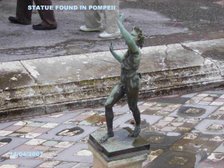
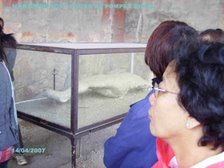
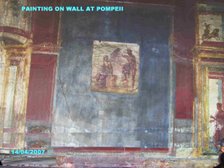
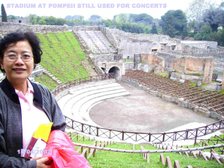
There is a market with walls depicted with fresco of fishes. Near this was a well preserved body of one of inhabitant of Pompeii. There were statues of some half human half animal god and remarkable well preseved pillars. There was a area which was supposed to be a brothel with rooms depicting frescos of different positions of sex. There was an arena which has converted to allow people to view modern rock concerts during certain festivals.
After a satisfying meal (the best pizza in Italy) at the restaurant outsde the entrance, we retired to our hotel for the night.

Places Visited In Trip to Italy April 2007

Rome

-Colossuem
-Trevis Fountain


Vatican City


-Vatican Museum
-Sistine Chapel
-St Peter's Basilica
-St Peter's Square

Rome

-St Peter in chains
-Pantheon

Pompeii

-ruins

Naples

-Isle of Capri
-Sorrento
-Assisi
-Siena

Florence

Venice

Verona

Milan

Blog Archive

About Me

My photo
A newbie to world of internet marketing. At the age of 59 years, I am struggling to learn the ins and outs of online marketing. I am a educator,part-time healthcare worker,computer hardware hobbyist,now ebook writer and internet marketer. I am also a full time lifelong learner. Graduated in 1972, did my Masters in 1991 and doctorate in 1993.

profile

profile
profile
 
http://kenkee.blogspot.com/ 2009-01-06 monthly 0.