User-agent: * Allow: / Trip to Italy April 2007: Duomo
Showing posts with label Duomo. Show all posts

Friday, 29 June 2007

OUR TRIP TO ITALY APRIL 2007

It was our first trip to Italy.

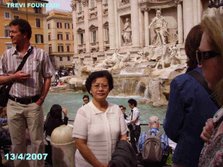
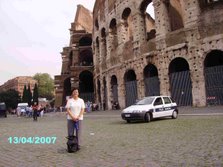
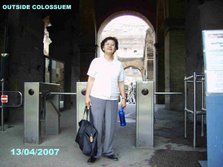
W e expected to see a lot of ancient civilisation( ROME, POMPEII), the religious center of the World (VATICAN CITY), icons of Italy (NICOLOSSEUM, LEANING TOWER OF PISA, VENICE, TREVI FOUNTAIN), wonderful statues and frescos, paintings, architecture and the culture of a country known for its history and its famous people( MICHAELANGELO, LEONARDO DA VINCI, GALILEO, ST PETER, ST FRANCIS OF ASSISSI,MARCO POLO).

All these we visited and saw the beauty of Italy.

Some advice we wished to give new visitors:

Parking for coaches are always very far from the tourist spots so be prepared to walk a lot. Try and get comfortable sport shoes.

During summer it can be very hot so buy lots of water to drink during your trip.
Water can be bought at different prices in the country. Rome and Vatican city are the most expensive with 500cc of water costing 3.50 euros while at Florence we were able to get 12 litres of water for only 0.99 euros.

The sun can also be very glaring to the eyes. We advise bringing good UV block sunglasses or wear a hat or cap.

Most of the big shops uses the major credit cards such as VISA, MASTERCARD, DINERS CLUB, AMERICAN EXPRESS but for the small stall holders selling souveniers cash is still important.

Bring sufficient cash for incidental buying of souvenier, food, icecream, even the usage of toilets etc. Remember that there are many pickpockets in Italy so keep your valuables(cash, credit cards, and passports) in a body pouch. It is safer than to lose your valuables to the pickpockets.

All services and goods carry a value added tax of 20% which can be refunded at the customs in the airport provided the amout is large enough. Get a form filled up at the shop where you buy the goods.

The hotels in Italy are generally comfortable but do not come with amenities like kettle, teabags or coffee. So if you need to boil water, bring along a travel kettle. Remember to bring the the right plug for the electical socket.
There is no airconditioning in most hotels but there are heaters for winter. Services like porters are slow so expect to receive your luggage late. It is better if you can bring the luggage up to your rooms yourselves.

Most Italians speak very little English. So try to learn a few Italian phrases.

Internet services cost about 5 euros for half an hour.

We found that there are a lot of illegal immigrants such as Africans and Asians selling fake goods along the roadside.

Once on the way to our hotel there was a blockage ot the road by the police as a result of strike by some workers working in factories. As a result the coach had to U turn and go by an alternative route.

Not all the toilets are free. Some cost 0.5 to 1 euro per entry. Best places to use a toilet would be at MacDonalds or you may be able to use a toilet at a food shop provided you buy food from them. No purchase means no usage of their toilets.

Bring sufficient batteries for your camera or bring the charger for your camera. If you don't then all the pictures which you take for your vacation will be wasted. The cost of batteries are very high in Italy.

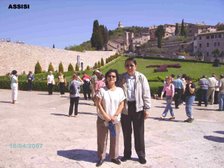
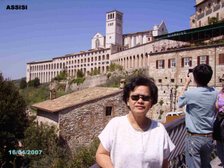
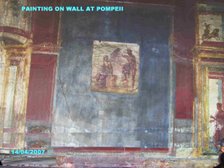
Photo taking are prohibited in many places in Italy especially where there are frescos as the flash damages the painting. Examples are Sistine Chapel, Pompeii, Assissi.

Churches or Basilica are places of worship so your dress code should be decent-no mini skirts and exposed shoulders. Silence is also important!

The largest lemon in the world can be found in Sorrento.

Finally enjoy your trip to Italy as we did with all these tips and precautions.

Tuesday, 19 June 2007

OUR TRIP TO ITALY APRIL 2007 - FLORENCE

Next from SIENA we travel to the important city of Florence.

Florence is the capital city of the region of
Tuscany, Italy.
From 1865 to 1870 the city was also the capital of
the Kingdom of Italy. Florence lies on the Arno
River and has a population of around 400,000
people, plus a suburban population in excess of
200,000 persons. The greater area has some
956,000 people. A center of medieval European
trade and finance, the city is often considered the
birthplace of the Italian Renaissance and was long
ruled by the Medici family. Florence is also famous
for its magnificent art and architecture. It is said
that, of the 1,000 most important European artists
of the second millennium, 350 lived or worked in
Florence. The city has also been called the Athens
of the Middle Ages.
The historic Center of Florence was declared a
World Heritage Site by the UNESCO in 1982.
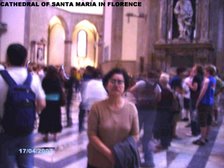
The best-known site and crowning architectural
jewel of Florence is the domed cathedral of the
city, Santa Maria del Fiore, known as The Duomo.
The magnificent dome was built by Filippo
Brunelleschi.
The nearby Campanile tower and the Baptistery

buildings are also highlights. Both the dome itself and the
campanile are open to tourists and offer excellent
views.
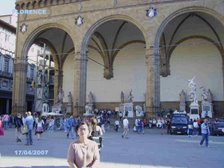
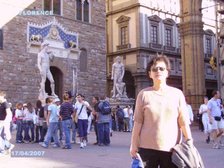
At the heart of the city in Piazza della Signoria is
Bartolomeo Ammanati's Fountain of Neptune,
which is a masterpiece of marble sculpture at the
terminus of a still functioning Roman aqueduct.
One of the bridges in particular stands out as
being unique — The Ponte Vecchio (Old Bridge),
whose most striking feature is the multitude of
shops built upon its edges, held up by stilts. The
bridge also carried Vasari's elevated corridor
linking the Uffizi to the Medici residence.

First constructed by the Etruscans in
ancient times, this bridge is the only one in the
city to have survived World War II intact.
The San Lorenzo contains the Medici Chapel, the
mausoleum of the Medici family - the most
powerful family in Florence from the 15th to the
18th century. Nearby is the Uffizi Gallery, one of
the finest art galleries in the world - founded on a
large bequest from the last member of the Medici
family.
The Uffizi itself is located on the corner
of Piazza della Signoria, a site important for three
main reasons:
In 1301, Dante was sent into Exile from here (a
plaque on one of the walls of the Uffizi
commemorates the event). In 1497,

it was the location of the Bonfire of the
Vanities
(a plaque in the middle of the plaza
commemorates that event), followed in 1498 by
the execution of its instigator, Girolamo
Savonarola
In 1504, it was the original location of
Michelangelo's David (now replaced by a
reproduction as the original was moved indoors to
the Accademia dell'Arte del Disegno), in front of
the Palazzo della Signoria (also known as Palazzo
Vecchio). In addition to the Uffizi, Florence has other
world-class museums:
The Bargello concentrates on sculpture,
containing many priceless works of art created by
such sculptors as Donatello, Giambologna, and
Michelangelo.
The Accademia dell'Arte del Disegno (often simply
called the Accademia) collection's highlights are
Michelangelo's David and his unfinished Slaves.
Across the Arno river is the huge Pitti Palace containing
part of the Medici family's former private
collection. In addition to the Medici collection the
palace's galleries contain a large number of
Renaissance works, including several by Raphael
and Titian as well as a large collection of modern
art, costumes, cattiages, and porcerlain. Adjoining
the Palace are the Boboli Gardens, elaborately
landscaped and with many interesting sculptures.
The elaborate Santa Croce church contains the
monumental tombs of Galileo, Michelangelo,
Machiavelli, Dante (actually a cenotaph), and many
other notables.

Other important basilicas in Florence include
Santa Maria Novella, San Lorenzo, Santo Spirito
and the Orsanmichele.
Florence has been the setting for numerous works
of fiction and movies, including the novels and
associated films Hannibal, Tea with Mussolini and
A Room with a View.


Notable residents

Leone Battista Alberti, polymath.

Dante Alighieri, The famous poet & writer

of La Divina Commedia.(Divine Comedy)

Filippo Brunelleschi, famous architect.

Giovanni Boccaccio, famous poet.

Giotto di Bondone, early Trecento painter of the
Arena Chapel in Padua, the Bardi and Peruzzi
chapels in the Basilica di Santa Croce di Firenze,
and many great panel works including the
Ognisanti Madonna .

Michelangelo Buonarroti, a famous sculptor, also
famous for the ceiling of the Sistine Chapel.

Medici Family

Girolamo Mei, historian and humanist

Lorenzo Ghiberti, sculptor

Donatello, sculptor

Raphael, painter.

Leonardo da Vinci, famous for his Mona Lisa and
other paintings, inventions, and scientific
experiments.

Niccolò Machiavelli, famous Renaissance poet and
philosopher

Giorgio Vasari, painter, architect, and historian

Galileo Galilei, Italian physicist, astronomer, and
philosopher.

Vincenzo Galilei Frescobaldi Family, notable bankers and wine
producers

Oriana Fallaci, journalist and author

Florence Nightingale, pioneer of modern nursing,
and a noted statistician.


The number of important authors, painters, sculpters, scientist, politician, architects and nursing legends made Florence a famous city both for its impotance and culture. The Academia museum which holds the original Michaelangelo's David, many original paintings by Raphael, works by Leonardo Da Vinci had to be booked in advance for several months so for mere tourists like us there were no hope of entering.

Monday, 18 June 2007

OUR TRIP TO ITALY APRIL 2007 - SIENA

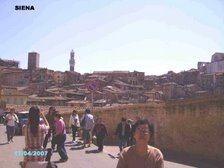
From ASSISI we travel to the medieval city of SIENA

Siena is a city in Tuscany, Italy. It is the capital of the province of Siena.The historic center of Siena has been declared by UNESCO a World Heritage Site.
Siena like other Tuscan hill towns, was first settled in the time of the Etruscans (c. 900 BC to 400 BC) when it was inhabited by a tribe called the Saina. The Etruscans were an advanced people who changed the face of central Italy through their use of irrigation to reclaim previously unfarmable land, and their custom of building their settlements in well-defended hill-forts. .
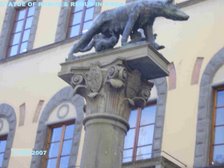
The Roman origin accounts for the town's emblem – a she-wolf suckling the infants Romulus and Remus. According to legend, Siena was founded by Senius, son of Remus, who was in turn the brother of Romulus, after whom Rome was named. Statues and other artwork depicting a she-wolf suckling the young twins Romulus and Remus can be seen all over the city of Siena. Siena did not prosper under Roman rule. It was not sited near any major roads and therefore missed out on the resulting opportunities for trade. Its insular status meant that Christianity did not penetrate until the fourth century AD, and it was not until the Lombards invaded Siena and the surrounding territory that it knew prosperity. Their occupation and the fact that the old Roman roads of Aurelia and the Cassia passed through areas exposed to Byzantine raids, caused the roads between the Lombards' northern possessions and Rome to be re-routed through Siena. The inevitable consequence of this was that Siena prospered as a trading post, and the constant streams of pilgrims passing to and from Rome were to prove a valuable source of income in the centuries to come.
It was during the 1100s that the majority of the construction of the Duomo, Siena's cathedral, was completed. It was also during this period that the Piazza del Campo, now regarded as one of the most beautiful civic spaces in Europe, grew in importance as the centre of secular life. New streets were constructed leading to it and it served as the site of the market, and the location of various sporting events . On September 4, 1260 The Senese Ghibellines, supported by the forces of King Manfred of Sicily, defeated the Florentine Guelphs at Montaperti. The Senese faced an overwhelming Florentine army. Prior to the battle, the entire city was dedicated to the Virgin Mary and entrusted to her possession – something which has been renewed several times since, most recently in 1944 to guard the city from the threat of Allied bombs. The man given command of Siena for the duration of the war, Bonaguida Lucari, walked barefoot and bareheaded, a halter around his neck, to the Duomo. Leading a procession composed of all the city's residents, he was met by all the clergy. Lucari and the Bishop embraced, to show the unity of church and state, then Lucari formally gave the city and contrade to the Virgin. Legend has it that a thick white cloud descended on the battlefield, giving the Senese cover and aiding their attack. They inflicted a crushing defeat and massacred the forces of their enemy,so crushing was the defeat that even today if the two cities meet in any sporting event, the Senese supporters are likely to exhort their Florentine counterparts to “Remember Montaperti!”.
Siena's university, founded in 1203 and famed for its faculties of law and medicine, is still among the most important Italian universities. Siena was devastated by the Black Death of 1348, and also suffered from ill-fated financial enterprises.

On the Piazza Salimbeni is the Palazzo Salimbeni, a notable building and also the medieval headquarters of Monte dei Paschi di Siena, one of the oldest banks in continuous existence and a major player in the Sienese economy.

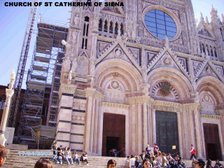
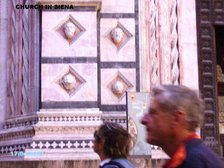
Siena's cathedral, the Duomo, begun in the twelfth century, is one of the great examples of Italian romanesque architecture. Its main facade was completed in 1380. Its campanile and baptistery make a fine group. It is unique among Christian cathedrals in that its axis runs north-south. This is because it was originally intended to be the largest cathedral in existence, with a north-south transept and an east-west aisle, as is usual.

Inside is the famous Gothic octagonal pulpit by Nicola Pisano (1266–1268) supported on lions, and the labyrinth inlaid in the flooring, traversed by penitents on their knees. Also present near the pulpit was the head of St Catherine of Siena. Her body however remains in Rome.

Sanctuary of Santa Caterina, incorporating the old house of St. Catherine of Siena. It houses the miraculous Crucifix (late 12th century) from which the saint received her stigmata, and a 15th century statue of St. Catherine.

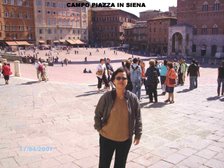
The shell-shaped Piazza del Campo, the town square, which houses the Palazzo Pubblico and the Torre del Mangia, is another architectural treasure, and is famous for hosting the Palio horse race.

July 2 and August 16 are the dates when the "Palio" is held. The Palio is a traditional horse race which is run around the Piazza del Campo each year. This event is attended by large crowds, and is widely televised.

Places Visited In Trip to Italy April 2007

Rome

-Colossuem
-Trevis Fountain


Vatican City


-Vatican Museum
-Sistine Chapel
-St Peter's Basilica
-St Peter's Square

Rome

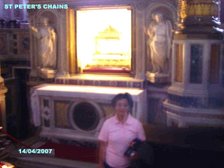
-St Peter in chains
-Pantheon

Pompeii

-ruins

Naples

-Isle of Capri
-Sorrento
-Assisi
-Siena

Florence

Venice

Verona

Milan

Blog Archive

About Me

My photo
A newbie to world of internet marketing. At the age of 59 years, I am struggling to learn the ins and outs of online marketing. I am a educator,part-time healthcare worker,computer hardware hobbyist,now ebook writer and internet marketer. I am also a full time lifelong learner. Graduated in 1972, did my Masters in 1991 and doctorate in 1993.

profile

profile
profile
 
http://kenkee.blogspot.com/ 2009-01-06 monthly 0.