User-agent: * Allow: / Trip to Italy April 2007: Vatican City
Showing posts with label Vatican City. Show all posts

Friday, 29 June 2007

OUR TRIP TO ITALY APRIL 2007

It was our first trip to Italy.

W e expected to see a lot of ancient civilisation( ROME, POMPEII), the religious center of the World (VATICAN CITY), icons of Italy (NICOLOSSEUM, LEANING TOWER OF PISA, VENICE, TREVI FOUNTAIN), wonderful statues and frescos, paintings, architecture and the culture of a country known for its history and its famous people( MICHAELANGELO, LEONARDO DA VINCI, GALILEO, ST PETER, ST FRANCIS OF ASSISSI,MARCO POLO).

All these we visited and saw the beauty of Italy.

Some advice we wished to give new visitors:

Parking for coaches are always very far from the tourist spots so be prepared to walk a lot. Try and get comfortable sport shoes.

During summer it can be very hot so buy lots of water to drink during your trip.
Water can be bought at different prices in the country. Rome and Vatican city are the most expensive with 500cc of water costing 3.50 euros while at Florence we were able to get 12 litres of water for only 0.99 euros.

The sun can also be very glaring to the eyes. We advise bringing good UV block sunglasses or wear a hat or cap.

Most of the big shops uses the major credit cards such as VISA, MASTERCARD, DINERS CLUB, AMERICAN EXPRESS but for the small stall holders selling souveniers cash is still important.

Bring sufficient cash for incidental buying of souvenier, food, icecream, even the usage of toilets etc. Remember that there are many pickpockets in Italy so keep your valuables(cash, credit cards, and passports) in a body pouch. It is safer than to lose your valuables to the pickpockets.

All services and goods carry a value added tax of 20% which can be refunded at the customs in the airport provided the amout is large enough. Get a form filled up at the shop where you buy the goods.

The hotels in Italy are generally comfortable but do not come with amenities like kettle, teabags or coffee. So if you need to boil water, bring along a travel kettle. Remember to bring the the right plug for the electical socket.
There is no airconditioning in most hotels but there are heaters for winter. Services like porters are slow so expect to receive your luggage late. It is better if you can bring the luggage up to your rooms yourselves.

Most Italians speak very little English. So try to learn a few Italian phrases.

Internet services cost about 5 euros for half an hour.

We found that there are a lot of illegal immigrants such as Africans and Asians selling fake goods along the roadside.

Once on the way to our hotel there was a blockage ot the road by the police as a result of strike by some workers working in factories. As a result the coach had to U turn and go by an alternative route.

Not all the toilets are free. Some cost 0.5 to 1 euro per entry. Best places to use a toilet would be at MacDonalds or you may be able to use a toilet at a food shop provided you buy food from them. No purchase means no usage of their toilets.

Bring sufficient batteries for your camera or bring the charger for your camera. If you don't then all the pictures which you take for your vacation will be wasted. The cost of batteries are very high in Italy.

Photo taking are prohibited in many places in Italy especially where there are frescos as the flash damages the painting. Examples are Sistine Chapel, Pompeii, Assissi.

Churches or Basilica are places of worship so your dress code should be decent-no mini skirts and exposed shoulders. Silence is also important!

The largest lemon in the world can be found in Sorrento.

Finally enjoy your trip to Italy as we did with all these tips and precautions.

Wednesday, 13 June 2007

OUR TRIP TO ITALY APRIL 2007 - ST PETER'S SQUARE

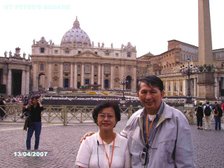
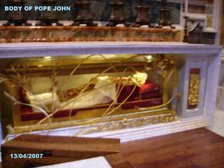
After St Peter's Basilica, where we took a photo of Pope John XX 's body and tomb, we landed in St Peter's Square. It was just after Easter and there were still lots of chairs in the Square where the Easter Sunday Mass was held. We were able to see the buildings that surround the Square and the famous Egyptian obelisk in the centre. The Vatican Obelisk is the only obelisk in Rome that has not toppled since Roman times. it was brought to Rome by Caligula in 38BC from the town of Heliopolis, on the Nile Delta.
St Peter's Square is the large public square outside St Peter's Basilica, which is considered the greatest church on Earth. The square is actually round, with the perimeter marked by two huge colonnades. The roofs of these colonnades are supported by four rows of Doric columns 60-feet tall. The ellipse symbolizes Saint Peter's, the mother church of Christianity, embracing the world. The obelisk is flanked by two fountains, and halfway between the fountains and the obelisk are stone circles in the ground. If you stand on one of the circles, you can see an optical illusion -- the four rows of 60-foot tall pillars forming the colonnade disappear behind each other and look like a single row. The piazza has to be large to accommodate the throngs that show up at noon on Sundays and several other times each week to hear the Pope say mass and to receive his blessing. As it is now, the square can handle about 300,000 people but has been known to pack in more. The Pope delivers his blessing from a library window overlooking the square.
There is also a Souvenier shop which sells Catholic books, crosses, rosaries and other souveniers to worshippers and tourists. The prices were very reasonable.

Tuesday, 12 June 2007

OUR TRIP TO ITALY APRIL 2007 - ST PETER"S BASILICA

The End of the Sistine Chapel was in a large room with frescos of The New Testament on one wall and The Old Testament on the opposite wall.
It is here that that the cardinals will pray to choose the next Pope. From here we leave the beautiful Sistine Chapel with the wonderful art of Michaelangelo( Remember the book and Movie "The Agony and the Ectacsy" which deals with the emotional state of Michaelangelo as he is torn between helping his Pope and his desire to return to his home in Florence.
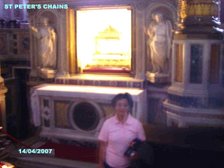
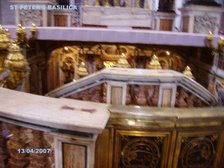
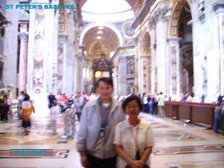
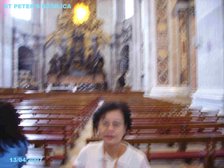
We then entered the St Peter's Basilica where most of the Popes including St Peter were buried and where the Pope celebrates Mass.
The Basilica of Saint Petrus, officially known in Italian as the Basilica di San Pietro in Vaticano and commonly called Saint Peter's Basilica, is one of four major basilicas of Rome (St. John Lateran, St. Peter's, Santa Maria Maggiore and St. Paul outside the Walls).
It is the most prominent building inside the Vatican City. Its dome is also a dominant feature of the Roman skyline. Saint Peter's is also incidentally the patriarchal basilica of Constantinople whereas the Lateran Basilica is the patriarchal basilica of Rome.
Possibly the largest church building in Christianity[2], it covers an area of 5.7 acres (2.3 ha) and has a capacity of over 60,000 people. One of the holiest sites of Christendom in the Catholic tradition, it is traditionally the burial site of its namesake Saint Peter, who was one of the twelve apostles of Jesus, first Bishop of Antioch, and later first Bishop of Rome. Although the New Testament does not mention Peter's presence or martyrdom in Rome, ancient tradition holds that his tomb is below the baldachin and altar; for this reason, many Popes, starting with the first ones, have been buried there.
Construction on the current basilica, over the old Constantinian basilica, began on April 18, 1506 and was completed in 1626[3].
Although the Vatican basilica is not the Pope's official ecclesiastical seat (Saint John Lateran), it is most certainly his principal church, as most Papal ceremonies take place at St. Peter's due to its size, proximity to the Papal residence, and location within the Vatican City walls. The basilica also holds a relic of the Cathedra Petri, the episcopal throne of the basilica's namesake when he led the Roman church, but which is no longer used as the Papal cathedra. It is believed that a piece of this cathedra, or chair, is contained within the altarpiece, designed by Bernini.

The light coming down from the roof of the Basilica lights up the whole church. It was a masterpiece of architecture with lower and upper floor. The lower floor was where the Pope celebrates Mass with his cardinals and bishops while the upper floor was where the Pope celebrate Mass with the congregation.

Sunday, 27 May 2007

Welcome to our Tour Of Italy April 2007- Vatican Museums

Vatican Museums is one of the most important Museum in the world housing very important masterpieces from Egyptian Age to late Renaissance.

The museums are composed of several sections:
T
he Gregorian Etruscan Museum
was founded by Pope Gregory XVI in 1837 and mostly contains objects that starting from 1828 were found in the excavations of the ancient cities of southern Etruria , then part of the Pontifical State.

The Pinacoteca
was inaugurated on 27 October 1932 in the building especially constructed by the architect Luca Beltrami for Pope Pius XI.

The Missionary-Ethnological Museum
was founded on November 12, 1926 by Pope Pius XI (1922-1939) . It was established in the Lateran Apostolic Palace up to 1963, when the Pope John XXIII (1958-1963) had it transferred to the Vatican. It was opened to the public in 1973.

The Raphael Stanze
("Raphael's rooms") in the Palace of the Vatican form a suite of reception rooms, the public part of the papal apartments. They are famous for their frescos painted by Raphael and his workshop.

The Sistine Chapel
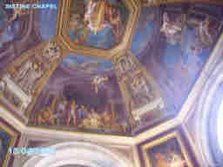
is a chapel in the Apostolic Palace, the official residence of the Pope, in the Vatican City. Its fame rests on its architecture, which evokes Solomon's Temple of the Old Testament, its decoration, frescoed throughout by the greatest Renaissance artists, including Michaelangelo whose ceiling is legendary, and its purpose, as a site of papal religious and functionary activity, notably the conclave at which a new Pope is selected.

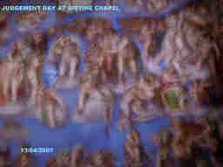
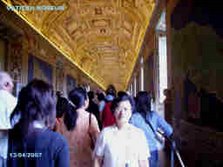
Finally after a half hour queue, we entered the entrance of the Vatican Museums. We passed through the large crowd, entered the Gregorian Museum, then the Raphael Stanze and up to the Sistine chapel. The sculptures and painting were incredible particularly those by Raphael and Michaelangelo. Walls and ceiling were filled with frescoes such as the Creation of Life and the Last Judgment. Words cannot describe the beauty of the Renaissance Arts. Only photos taken were able to capture a small percentage of what we saw with our naked eyes.

Vacation Trip to Italy April 2007 -Vatican City

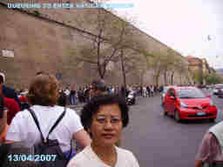
Next stop was Vatican City which is the smallest sovereign country in the world. Our coach has to cross the Tiber river to the west bank in order to reach the Vatican.
Vatican City, officially State of the Vatican City is a landlocked sovereign city-state whose territory consists of a walled enclave within the city of Rome. At approximately 44 hectares (108.7 acres), it is the smallest independent nation in the world.
It was created in 1929 by the Lateran Treaty as a vestige of the much larger Papal States (756 to 1870). Vatican City can be said to be the governmental capital of the Catholic Church.
The territory of Vatican City is part of the Mons Vaticanus, and of the adjacent former Vatican Fields where St. Peter's Basilica, the Apostolic Palace, the Sistine Chapel, and museums were built, along with various other buildings on the west bank of the Tiber river.
In 326, the first church, the Constantinian basilica, was built over the site that Catholic apologists as well as noted Italian archaeologists argue was the tomb of Saint Peter, buried in a common cemetery on the spot.
The papacy is a non-hereditary, elective monarchy, chosen by the College of Cardinals. He is the only absolute monarch in Europe.
The pope is elected for a life term in conclave by cardinals under the age of 80.
The current Pope is His Holiness Benedict XVI, born Joseph Alois Ratzinger in Bavaria, Germany.

The moment we entered the boundary of the Vatican City, we can see a large queue of at least 3 blocks long all waiting to enter the Vatican Museums, a treasure house of the Catholic faith with vast collections of ancient and Renaissance art. We joined the queue with a local guide who provided us with hand phones fixed at a certain frequency so that we can listen to his commentary. As the Vatican Museums which leads to the Sistine Chapel and St Peter's Basilica are places of worship, we were supposed to keep quiet and wear clothes appropriate to the location( ie no miniskirts,shorts,low cut blouses etc).

Places Visited In Trip to Italy April 2007

Rome

-Colossuem
-Trevis Fountain


Vatican City


-Vatican Museum
-Sistine Chapel
-St Peter's Basilica
-St Peter's Square

Rome

-St Peter in chains
-Pantheon

Pompeii

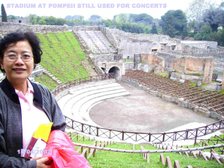
-ruins

Naples

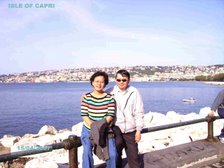
-Isle of Capri
-Sorrento
-Assisi
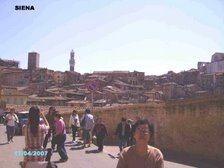
-Siena

Florence

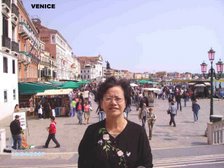
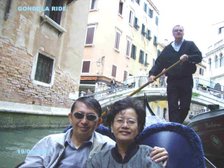
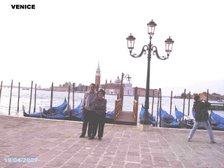
Venice

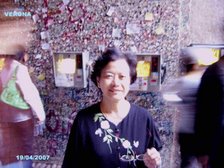
Verona

Milan

Blog Archive

About Me

My photo
A newbie to world of internet marketing. At the age of 59 years, I am struggling to learn the ins and outs of online marketing. I am a educator,part-time healthcare worker,computer hardware hobbyist,now ebook writer and internet marketer. I am also a full time lifelong learner. Graduated in 1972, did my Masters in 1991 and doctorate in 1993.

profile

profile
profile
 
http://kenkee.blogspot.com/ 2009-01-06 monthly 0.